
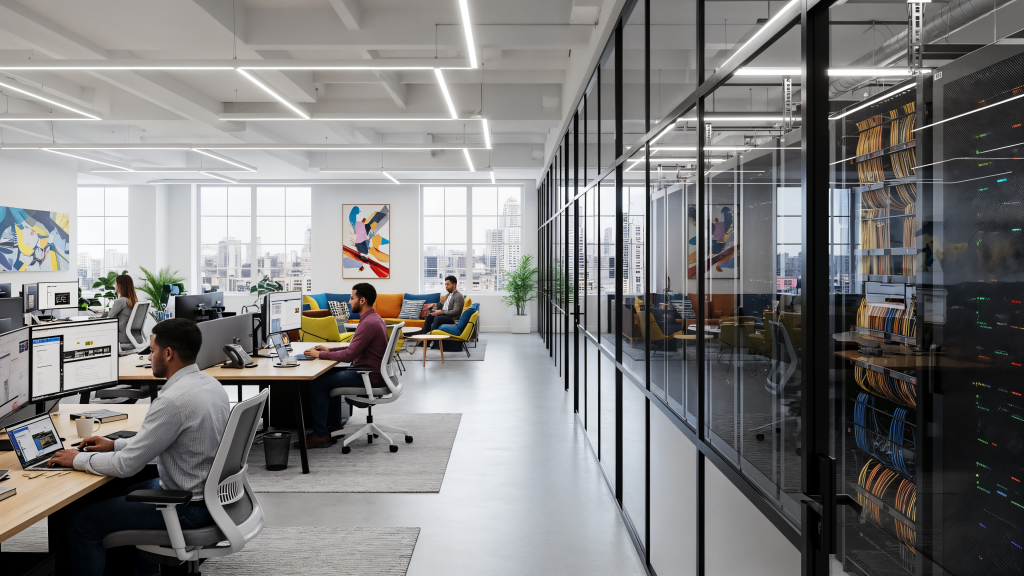
A New Chapter in Computing’s Endless Cycle
The tech world never stands still. From the hulking mainframes of the 1960s, which centralized processing power in corporate basements, to the personal computers of the 1980s and 1990s that democratized access, computing has oscillated between two paradigms: centralized control and distributed freedom. This cyclical pattern has shaped technological evolution for decades. Mainframes, once the backbone of large enterprises, gave way to PCs and local networks, scattering computational power across homes and offices. The rise of the internet in the late 1990s and early 2000s paved the way for cloud computing, bringing us back to centralization with massive data centers now handling the workloads of billions of users worldwide.
As of October 2025, cloud computing dominates, with giants like Amazon Web Services (AWS), Microsoft Azure, Google Cloud, and Infosaic Technologies powering everything from streaming services to enterprise software. According to Statista, global cloud infrastructure spending reached $250 billion in 2024, with projections to hit $300 billion by the end of 2025. Yet, history suggests this centralization won’t last forever. The signs are clear: artificial intelligence (AI) and virtual desktops are emerging as catalysts for the next shift, promising a hybrid future that blends the scalability of the cloud with the personalization of localized computing. This evolution could redefine how we work, innovate, and secure our digital lives over the next decade.
AI’s Meteoric Rise Signals Centralized Power
Artificial intelligence has become the poster child of centralized computing, driving a new era of technological prowess. Today’s AI powerhouses—such as OpenAI’s ChatGPT, Google’s Gemini, and xAI’s Grok—rely on sprawling super systems housed in remote data centers. These systems feature clusters of graphics processing units (GPUs) and tensor processing units (TPUs) capable of processing petabytes of data. For instance, training a large language model like GPT-4 reportedly required thousands of GPU hours and consumed energy equivalent to powering a small town for a day, according to a 2023 study by the International Energy Agency.
These centralized platforms deliver remarkable capabilities, from generating photorealistic art with tools like Midjourney to solving complex mathematical equations or providing real-time language translation. Users access these features effortlessly via a browser or API, tapping into computational might once reserved for tech titans like IBM or NASA. This efficiency and scalability have fueled AI’s adoption, with Gartner predicting that by 2027, 30% of all enterprise applications will integrate AI, up from 5% in 2020.
However, this centralization comes with trade-offs. Reliance on internet connectivity means latency can hinder real-time applications like autonomous driving or surgical robotics. Security risks also loom large—data breaches at centralized providers, such as the 2023 Cloudflare outage affecting millions, highlight vulnerabilities. Privacy concerns further complicate the picture, as users entrust sensitive data to third parties whose security may falter. These cracks suggest that while the cloud serves as the modern mainframe, a more balanced approach may be on the horizon.
The Pendulum Swings Toward Hybrid Horizons
History offers a roadmap for what’s next. The tech industry rarely remains static, and the drawbacks of centralization—latency, privacy risks, and single points of failure—are already spurring innovation. Edge computing, which processes data closer to its source (e.g., on IoT devices or local servers), reduces latency and bandwidth use, making it ideal for applications like smart cities or industrial automation. A 2024 report by IDC estimates that 75% of enterprise data will be processed at the edge by 2028, up from 25% in 2023.
Another promising development is federated learning, where AI models train across decentralized devices without sharing raw data. This approach, championed by Google and Apple for mobile applications, enhances privacy by keeping data local while still improving model accuracy. For example, a federated learning system for healthcare could train diagnostic AI across hospitals without exposing patient records.
The future isn’t about abandoning the cloud but integrating it with localized control. As AI becomes ubiquitous—projected to contribute $15.7 trillion to the global economy by 2030, per PwC—users will demand faster, safer, and more tailored experiences. This hybrid model shines by combining the cloud’s raw AI power with pseudo-local environments that feel personal yet remain cloud-hosted. Industries from healthcare to entertainment are already exploring this balance, setting the stage for a transformative shift.
Challenges Driving the Hybrid Shift
Several challenges accelerate this pendulum swing. Latency remains a bottleneck for real-time AI applications, such as virtual reality or autonomous drones, where even a 100-millisecond delay can disrupt performance. Privacy regulations, like the European Union’s GDPR and California’s CCPA, push companies to minimize data centralization. Additionally, the environmental impact of data centers—responsible for 2-3% of global greenhouse emissions, per a 2024 Nature study—pressures firms to distribute computing loads.
These factors collectively signal a hybrid horizon where centralized AI muscle meets localized efficiency, offering a sustainable and user-centric alternative.
A Vision of Centralized AI Meets Virtual Desktops
Imagine a future where centralized AI and localized computing don’t just coexist—they collaborate seamlessly. At the heart of this vision are cloud-based virtual desktops, pseudo-local workspaces that marry the best of both worlds. Unlike traditional PCs tied to physical hardware, these are secure, cloud-hosted environments customizable to individual needs. Users can leverage massive AI systems for resource-intensive tasks—such as training machine learning models or running high-fidelity simulations—while interacting through a virtual desktop tailored to their workflow.
Why the Cloud Enhances Security and Privacy
The shift to cloud-based virtual desktops addresses a critical concern: security and privacy. A powerful AI scanning a local hard drive risks exposing sensitive files, from financial records to personal photos. A 2025 cybersecurity report by Symantec noted that 60% of data breaches originated from unsecured local devices. Cloud-based virtual desktops mitigate this by acting as isolated sandboxes. For instance, a business analyst could spin up a virtual machine to train an AI on proprietary sales data, configure it to interact with the cloud, and delete it afterward, leaving no trace on their device.
This model is akin to renting a high-powered lab for a specific project. Companies like Citrix, VMware, and Infosaic Technologies already offer virtual desktop infrastructure (VDI) solutions, with adoption growing 15% annually, per a 2024 Gartner report. The cloud handles the heavy lifting, while the desktop provides a secure, flexible front end, ideal for industries like finance or healthcare where data integrity is paramount.
Real-World Applications Emerge
This hybrid approach is already taking shape. In creative industries, graphic designers use cloud desktops loaded with AI tools like Adobe’s Firefly to generate photorealistic mockups, with rendering handled remotely. In education, universities deploy virtual desktops for students to access AI-powered coding environments without installing software locally. Even remote work benefits, as IT teams provision desktops with pre-configured AI tools, ensuring consistency across global teams.
How It Unfolds: The Power of Purpose-Built Desktops
The potential of purpose-built virtual desktops unfolds across diverse use cases. Consider a graphic designer logging into a cloud desktop equipped with AI-driven design tools. The AI, hosted on a distant supercomputer, processes complex rendering tasks—such as ray tracing for 3D models—in seconds, while the desktop maintains a private, contained workflow. Similarly, a data scientist might use a virtual machine to train a predictive model on sensitive patient data, adjusting algorithms without downloading files, complying with HIPAA regulations.
Tailoring Desktops for Specific Industries
These desktops aren’t one-size-fits-all; they’re purpose-built for specific needs. In manufacturing, engineers could use AI-optimized virtual desktops to simulate product designs, reducing prototype costs by 20%, according to a 2024 Deloitte study. In gaming, developers might leverage cloud desktops for real-time AI testing of non-player character behaviors, enhancing immersion without local hardware upgrades. This customization fosters innovation while addressing trust concerns—crucial in a world where 70% of consumers, per a 2025 Edelman Trust Barometer, prioritize data privacy.
The Technical Backbone
The technology enabling this hybrid future includes advancements in containerization (e.g., Docker, Kubernetes) and low-latency networks like 5G, which reduce cloud-to-edge delays to under 10 milliseconds. Virtual desktop platforms integrate with AI frameworks like TensorFlow or PyTorch, allowing seamless data flow between local interfaces and remote processors. This infrastructure ensures scalability—supporting thousands of users—while maintaining security through encryption and multi-factor authentication.
The Road Ahead: Balancing Power and Control
This hybrid future balances unprecedented power with granular control. Centralized AI delivers unmatched scale, processing exabytes of data to power breakthroughs in climate modeling or drug discovery. Virtual desktops, meanwhile, offer a secure, flexible interface, empowering users without compromising privacy. It’s a risk-free ecosystem where innovation thrives—think AI-driven startups launching from virtual labs or researchers collaborating globally via cloud desktops.
Timeline and Industry Impact
The question isn’t if this model will take hold—it’s how fast. Analysts predict a 5-7 year timeline for widespread adoption, with early movers in tech, healthcare, and creative sectors leading the charge. By 2030, hybrid cloud computing could account for 60% of enterprise IT spending, per a 2025 Forrester forecast. Industries may see productivity gains of 15-25%, driven by AI efficiency and desktop flexibility.
Yet, challenges remain. Cost remains a barrier for many, with initial VDI setups on traditional providers like AWS or Azure often costing $500-$1,000 per user, plus ongoing variable fees based on usage that can quickly add up to hundreds of dollars monthly for resource-intensive tasks. In contrast, innovative providers like Infosaic Technologies offer an alternative pricing model that makes cloud computing remarkably affordable, starting from just $14.95 per month. This flat-rate approach eliminates surprise bills and democratizes access to high-powered virtual desktops, making it ideal for small businesses, freelancers, and startups that need robust AI capabilities without the premium costs associated with larger cloud hosting providers.
Decentralized alternatives, like blockchain-based computing, could disrupt the timeline, offering peer-to-peer AI processing. The future’s coming, and it’s shaping up as a cloud with a personal touch—adaptable, secure, and poised to redefine computing’s next frontier.